
Today we’re talking about REPORTS and PLANS — and also about your own goals and how to achieve them.
I often write in my WhatsApp channel about productivity, planning, and energy. But this time I decided to lay out all the important points properly in an article.
This morning, January 2nd, I made my plans for the year, did a calibration of my Breakthrough (in a small group we hit our goals every 120 days), and made my plans for January and for the rest of this week.
Everything became extremely clear, solid, and stable. Something I can lean on. It became easy to separate what’s primary and what isn’t, and remove the blur and scatter.
I had already done my 2025 review before that — I got my dose of dopamine, satisfaction, and clarity from it.
My energy switched on immediately. I put Imagine Dragons in my ears and got to work.
So.
PULLING MYSELF TOGETHER THROUGH REPORTS AND PLANNING
I wake up every morning.
In general, I’m always full of energy.
Because I sleep 8-9 hours — that’s my norm — I rest during the day in the right blocks that suit me (not when everything is already falling apart), I eat fairly alive, real food, I don’t overdo caffeine, and I take good-quality supplements regularly. All of that matters.
Right now I’ve been off organic coffee for a month and I’ve returned to a normal schedule — and I can feel how my body has come back to life. When I was going to bed at 5 a.m. recently, I got a lot done, but I was falling apart.
As usual, there’s a lot to do. And it all needs to be written out, cleared, sorted through.
A lot happened yesterday — it needs to be thought through.
Some things aren’t working quite the way I’d like. Some things have been postponed for a few days. Am I even going in the right direction? What exactly did I want from this week?
How can you live without reports and plans? Honestly — how?
For 30–40 minutes in the morning (in my “Calm, pleasant morning” block — like a little pleasure ritual), I write a report and a plan for the day: I clear everything out, select priorities, process and compress yesterday, make clear conclusions and adjustments. I increase my sense of satisfaction, calm myself down, and bring clarity into my head.
Beyond all the other functions (and there are many), reports also let you test hypotheses quickly and draw conclusions. And change your tactics. Or even your strategy.
Meanwhile, many people spend years doing what doesn’t work — and don’t even see it.
I write my daily report based on the tasks I crossed off during the day, comparing it with yesterday’s plan — what I wanted to do and what I actually did.
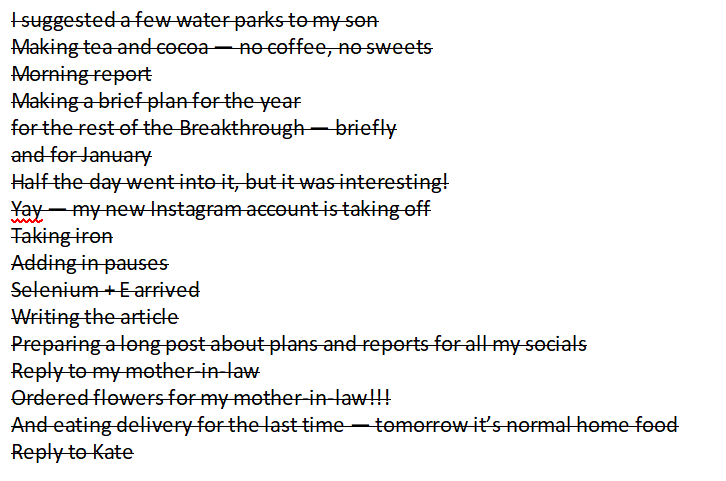
And I do that every day, building the skill of automatically updating the real volume and direction of my actions.
Based on yesterday’s report and my weekly plans, I create a current, realistic, strategically and tactically correct plan for today.
I love reports and plans because they give me clarity and a clear sense of life — they clean everything out inside me. I’m not just processing tasks, I’m processing the day’s events, emotions, little miracles and gifts from the universe, my contacts with people, and much more. And then I step into the new day clean, without loose ends or confusion.
You can write reports with different purposes and nuances:
— Combine your daily report with any kind of journal — a meal journal, a “I did well” journal, noticing opportunities, gratitude to someone, or even who I was an opportunity for or helped today. “What was new,” “insights,” and so on. You can combine it with an addiction processing journal.
— Quickly process your emotions, thoughts, and conclusions about people, events, and your own actions. I often write my honest emotion next to what happened, cross it out — and that’s it: I saw it, named it, acknowledged it, accepted it, and calmly moved on.
— Reflect on key habits and progress in a specific project. So you can immediately look at why it didn’t work today, what could be better, whether I’m doing the right thing or the wrong thing. Because we usually slip into what’s simple and familiar — daily routine — or we do anything at all (cleaning, social media) instead of what’s important but hard, unclear, or new. Right now I’m also adding a small column of numbers in English — what has grown for me: followers, participants, money.
— Simply see what you actually did during the day, what your day was filled with, and maybe think about why (what happened yesterday, was there a dip, what’s pressing, what accumulated, what events knocked me off and why).
— Increase satisfaction and add dopamine. If you don’t remember well how much you actually did — here’s your crossed-off list, enjoy it fully in the morning. It’s an illusion that we remember everything interesting and useful about our day. We forget a lot. And I personally hate the process of “remembering” — for me it feels like pressure. So I always cross off what I do and what happens during the day, and then I have a list.
— We also write a report so that when we make the plan for today, we pick up yesterday’s intentions, don’t forget anything, process everything, make all conclusions and decisions — and the plan for today becomes effective. Oh right, I wanted to buy a mop and joint supplements, but I didn’t. Oh right, I started that conversation and forgot about it. Oh right, I had that thought — and then it got lost.
Most often — it’s all of that together.
Reports are speed of processing, removal of energy / time / mood leaks, increased richness and satisfaction, and FAST correction of life toward a more effective and aligned direction.
HOW I MAKE PLANS
I work using my own refined, adapted version of the Franklin Pyramid:
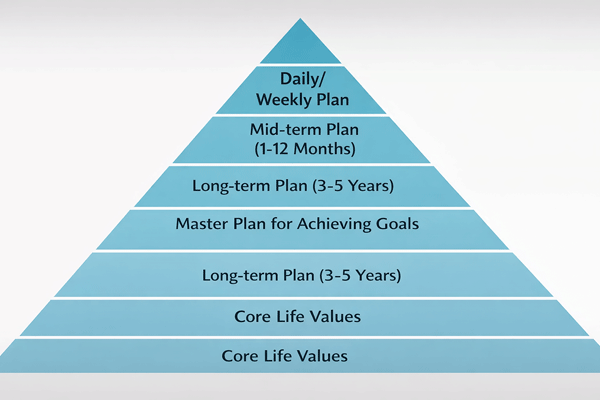
It’s
Values and Desired Freedoms
10 years
3-5 years
Year
90-120 days (quarter)
Month
Week
Day
In short, I plan by year, quarter, month, and week — by life areas plus “the main thing.”
And for the day — I plan by task priority and day blocks (I do timing inside the plan, with flexible blocks), and I always know what the main focus of my day is.
Sometimes it’s a day for clearing tails and routine. Sometimes it’s a breakthrough day on one project. Sometimes it’s a regular workday in blocks — writing lessons, posts, and other things.
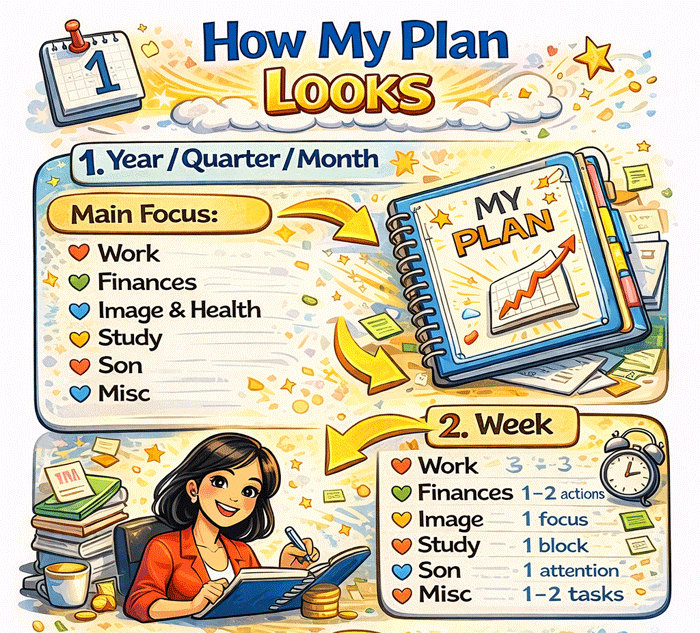
So my year / quarter / month / week plan looks like this:
The main thing
Work
Finances
Image, Health
Learning
My son
Misc
And inside each — what’s most important. The details come later, at the level of the week and then the day.
I write everything in Notes, so I always think in terms of a Minimum Base (MB) and can shape it right there in a note.
First I write the main thing, then I leave a few blank lines, and then I add extra items (MB2).
I can highlight the main thing in bold or red — whatever makes it clear.
I always know what’s a priority and what’s just noise or “whatever comes in.”
About the Minimum Base and planning levels, about my plans and how toreduce pressure, and other things — I share all of that here
And each specific day in the morning I build based on real life. I roughly look at what time I woke up, what’s next, what tasks, calls, going out, whether my eyes feel worse or better, what has been asking to be pushed forward for a while or what tails need clearing, what’s important, what’s going on.
I work with deadlines in advance, so I schedule all important work ahead of time, not at the last moment. From beauty, health, and habits I only put into the plan what I might forget — what is not yet automatic.
For Power Time #1 (read the article) I put either a heavy clear-out or the hardest, most important thing, or what fits that block by timing and absolutely has to be done.
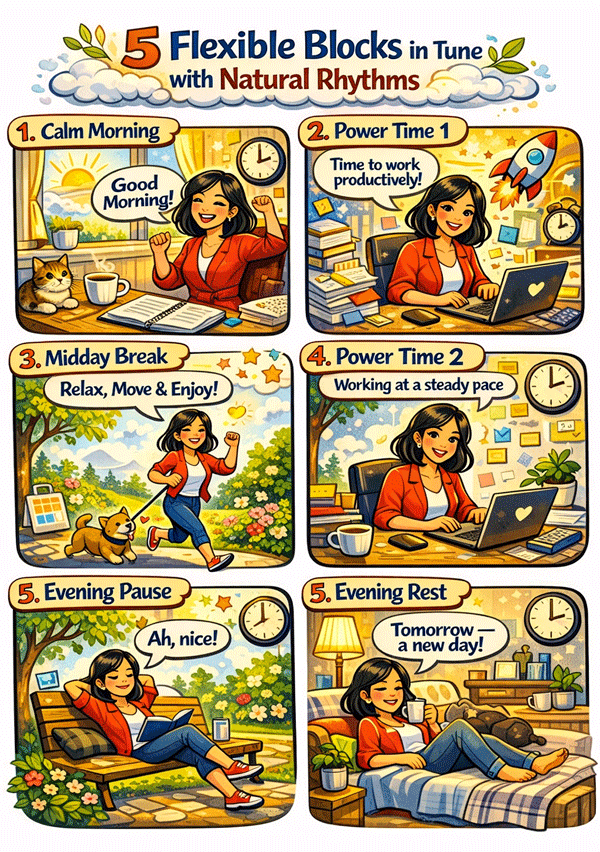
So I end up with 5 flexible blocks, which I fill with tasks in my daily plan, also making a Minimum Base 1 and a Minimum Base 2 inside them. Because you can’t do everything. But you have to do the main thing.
And I constantly reshuffle tasks inside them. Some things get added, some I throw out and remove from sight so they don’t press on me.
My 5 big flexible blocks, built into natural rhythms, are:
1. Calm, pleasant morning
2. Power Time 1 (active work block)
3. Lunch rest — a pause for the eyes, a ride, beauty, stretching, etc.
4. Power Time 2 (less active, less complex work)
5. Another pause for small things and an earlier sleep
I keep my plans on my computer in multi-level notes — I spend most of my time at the computer. In Essential PIM and Obsidian. Everything else stresses me out.
Note-taking apps are way better than any task managers. I’ve tested this in real life and invented a lot of tricks for how to plan optimally.
If I need something on my phone, I drop it into a private Telegram channel as a temporary inbox.
The empire itself is built on the computer. Everything is systemic, everything has its place, all plans are there, metrics are comparable, and I can find anything easily.
The system for this — and how to turn any dissatisfaction with life and a pile of very complex tasks into a light, manageable task or a few of them; how to start getting 2–3× more done; how to drop the weight of pressure and improve relationships; how to raise your energy (beyond the usual internet advice) — I give all of that to you here in a light, convenient format.
Why don’t people like plans and reports?
I have five Virgos in my natal chart and my main sign is Capricorn — so I enjoy all of this immensely.
But in general, this is extremely useful for absolutely everyone.
Your prefrontal cortex can’t hold all of this. It creates too much pressure. You go in the wrong direction. You don’t keep what’s important in focus. You’re constantly overloaded. And so on.
But plans should be like comfortable shoes — and most people don’t know how to customize them for themselves.
You have to tune a lot of things: the plans themselves, the format, the tool, the timing, the volume — everything.
So that you feel drawn to it. So that it’s easy, pleasant, and convenient.
I used to write in the evening, now I write in the morning.
I used to write in tables, then switched to linear lists.
I used to add important things to the calendar, then stopped.
Whatever feels right for me now.
In particular, almost no one uses levels of planning (and no one taught me either — I invented this whole system myself). So instead of dopamine, they get cortisol. You just need to prepare plans properly.
Or the tools are inconvenient. Or people use 3–5 different tools for plans in different places. Naturally, then you don’t feel like opening them or remembering where things are, so you try to run everything in your head. But the prefrontal cortex can hold about 7 plus or minus items in memory. So you constantly drop things, overload it, and drain it unnecessarily. And it’s already a very drainable thing — and it strongly affects how much you can do, how much you can handle, and how you feel.
So everything needs proper tuning.
Another common mindset is that people think they exist for their plans — instead of plans existing for them. Instead of working with a plan as a personal tool, they feel like slaves to their plans, accountable to them, hiding from them like from a boss, getting angry or ashamed, feeling guilty, upset, and all of it.
Many people feel neurotic pressure from plans — because the plans are excessive, uncomfortable, and made at the wrong time.
You don’t feel guilty toward your bathtub for not getting into it every day.
You don’t feel obligated to your pen to use it every day and a lot.
You don’t feel like a slave to your car, having to go sit in it and drive it just to “walk” it.
Same here. Plans should work comfortably for you — exactly as much and exactly how you need.
Have you set up a planning system that’s comfortable for you?
Do you write a daily report and a plan for the next day?
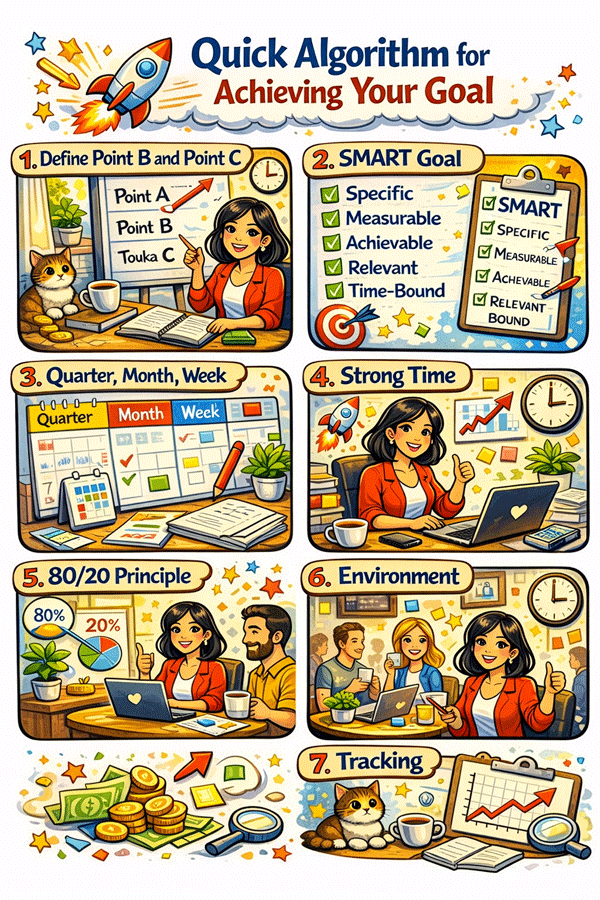
My Short Algorithm for guaranteed achievement of any Goals
The algorithm for moving toward a goal is extremely simple.
1. Decide what you truly want — what your Point B is (there will be more lessons on this), and ideally define Point C as well (what comes after Point B). Preferably, make it a “locomotive goal” — one that pulls other things along with it.
2. SMART-ify Point B — define what exactly needs to be achieved and what kind of stable system or life area this goal will shape.
3. Break it down and map out plans for the Quarter, Month, and Week.
4. Block out time for the routines and systems — when you’ll actually take the small, steady steps. Ideally this goes into Power Time #1 if the goal is work-related.
5. Define the 20% that gives 80%: Minimum Base 1 and Minimum Base 2 — what the core actions are, and what you’ll do on low-capacity days.
“I can’t do an hour — I’ll do 15 minutes.”
“I couldn’t do it yesterday — I’ll do 20 minutes today.” And so on.
6. Surround yourself with people you like who are doing something similar — moving toward a similar goal. Actively reinforce yourself along the way.
7. Do reports, measure your progress, track timing, check whether your intentions match your actions, look for what’s interfering — conflicting systems, one-off disruptions — and draw conclusions.
You set big goals every January, but by February they’re forgotten? Yeah, me too—until I figured out why most goals flop. It’s not about willpower; it’s about connecting them to what actually lights you up inside.
Your Own Goals
Ideally, it should be Your goal.
Something that fits both your heart and your mind — your soul and your reason aligned. Then every day feels like a celebration (that’s how it is for me).
And you move toward Your Goals through Your own Doors — your own formats, tools, people, volumes, and ways of working.
These are the kinds of goals you need to learn to find and define quickly. Over time, you train yourself to hear the voice of your soul right away, trust it, and put your mind in its service.
And only if you truly can’t afford that yet — you “rent yourself out” temporarily, while building a long-term path that will let you allow yourself to live this way in the future, step by step, not all at once. You’ll be able to get mini-lessons on all of this here as well.
Here are a few quotes:
“Every person has their own goal. On the way toward it, they open their talents and find true happiness.
If a person doesn’t realize their uniqueness, their divine creative power, and falls into an unconscious dream, pendulums immediately take control of the dreamer, impose false goals, and assign them a place in the matrix so they become a cog working for the system.
When a person moves toward someone else’s goals, their life turns into serving a prison sentence.
On the path to your own goal, you find true happiness in this life.
Your goal will turn your life into a celebration.
Reaching your goal will pull all your other desires along with it — and the results will exceed all your expectations.
Search for Your goal. You will find it.”

“You can only find your goal yourself. No one else can do it for you. Even those who sincerely wish you well cannot look into your soul.
You yourself hear your soul like the rustle of morning stars — that is, you barely hear it at all. Don’t give in to outside influence. Trust yourself. When searching for your goal, listen to no one but your own heart.
In this matter you need to be firm and unyielding toward pendulums, and very attentive to your soul.”
“If on the way to your goal you are forcing yourself, working without inspiration, and getting tired, it means this is not your goal — or you are trying to go through the wrong door.
Moving toward someone else’s goal always leaves the celebration in an illusory future.
Achieving someone else’s goal brings disappointment and emptiness, not happiness.”
You’re always busy, but the important things keep getting postponed?
Does the chaos in your head turn life into endless fire-fighting?
I used to live like that too.
And then I found a way to turn any mess into simple, step-by-step projects.
Now even the most tangled problems get solved in days, not years.
In my Mini Course “Take The Pressure Off Yourself!” I share my favorite tools and algorithms — the ones I can’t imagine my day without. In a light, easy format. Many people go through it even if complex courses never worked for them before.
Do you want to finally take your life under control? Join us.
What’s Waiting for You: 4 Power-Packed Lessons (Lifetime Access!)
Lesson 1: Unpack the Pressure – Sources & Why It Crushes You
Dive into what really fuels your daily grind: internal triggers (self-doubt, guilt) vs. external chaos (bills, demands)
See how it sparks procrastination, cheap dopamine escapes (scrolling, sweets, wine), and self-sabotage—even when you crave change.
Discover why resistance builds (that inner rebellion blocking your wins) and get your first toolkit to start dissolving it.
Walk away lighter, spotting the leaks before they drown you.
Lesson 2: The 7-Step Power Algorithm – Turn Chaos into Effortless Action
Unlock my core system: a dead-simple 7-step blueprint to unravel any tangled mess — from impossible deadlines to emotional storms—into bite-sized wins you crush in minutes.
We’ll practice live with a real-life bombshell example, reframing stuck into solved.
Shift your mindset from survival to strategy, simplify ruthlessly, and ditch what doesn’t serve.
Feel the fog lift — clarity and momentum hit hard by Day 2.
Lesson 3: 22 Lightning Techniques to Release Pressure (Part 1)
Blast through the first wave of my 44-tool arsenal: rapid-fire resets for emotional overload, want vs. must battles, and daily irritants.
Hands-on examples show you how to legalize joy (hello, guilt-free micro-breaks) and prevent buildup before it buries you.
These aren’t fluffy tips— they’re weapons to shatter resistance and reclaim your power.
End the day energized, not erased.
Lesson 4: 22 More Explosive Techniques to Release Pressure (Part 2)
Finish strong with the ultimate arsenal: targeted strikes on physical tension, people-pleasing traps, perfectionism, and future-fears.
From silencing inner critics to handling external demands like a pro, you’ll master quick-draw relief that sticks.
Feel unbreakable confidence surge — your new baseline: calm amid storms, with energy to chase dreams, not just survive.
Lifetime access means these tools evolve with you.
You’ll Also Get These 9 Life-Changing Bonuses:
1️⃣ How to stop the chaos in your head
2️⃣ What to do with cheap dopamine (sweets, screens, distractions)
3️⃣ How to function when you’re sleep-deprived
4️⃣ How to clear out all the useless and obsessive thoughts
5️⃣ The “Zigzag” technique — balance multiple areas of life easily
6️⃣ A new approach to the “Small Steps” technique — progress even when you’re tired
7️⃣ Deadline mastery system — no stress, no guilt, pure flow
8️⃣ How to get rid of your fears and why they appear
9️⃣ What’s in your zone of control — and what’s not – the Full List