Your strongest hours are actually the biggest advantage you have in life.
Most people throw them away at the very start of the day — and that’s the mistake.
That’s when they cut off their own effectiveness and productivity.

For 20 years, I have been studying and practicing ways to increase personal efficiency and make conscious life changes.
For the past years, I’ve been diligently working every day according to the “Power time of the day” system. This has become my conscious choice and the primary focus of my work routine.
I coined the term “Power Hours of the Day” myself, and I’ve been popularizing it ever since.
I keep developing and refining the theory, constantly testing add-ons and amplifiers, collecting stats and feedback on how it works for others.
Honestly, it’s surprising how little the internet talks about this. I’m still amazed.
I explain some of mymain theories in a very practical, clear way — with tons of hacks and tools — in my updated mini-couse (in PDF, 4 lessons) “Take The Pressure Off Yourself!” .
Takin pressure off youlself frees up space for sleep, rest, hobbies, beauty and health, learning, new projects — everything you want more of.
In this article, I’ll briefly share the core ideas behind Power Hours and other hacks and time-management secrets I use.
Thanks to this approach, I have successfully built a substantial online academy focused on personal effectiveness and self-development. The academy offers dozens of courses (not in English yet, in English a book and 2 main courses), including large and complex ones. Sometimes, I run three group formats daily and regularly provide consultations. In total, I have personally reviewed over 7,000 homework assignments for several years.
By consciously and fully utilizing the Power time of the day, my productivity has increased 3-5 times.
I have also managed to move from the “Urgent Unimportant” and “Urgent Important” quadrants of the Eisenhower matrix to the “Non-urgent Important” quadrant.
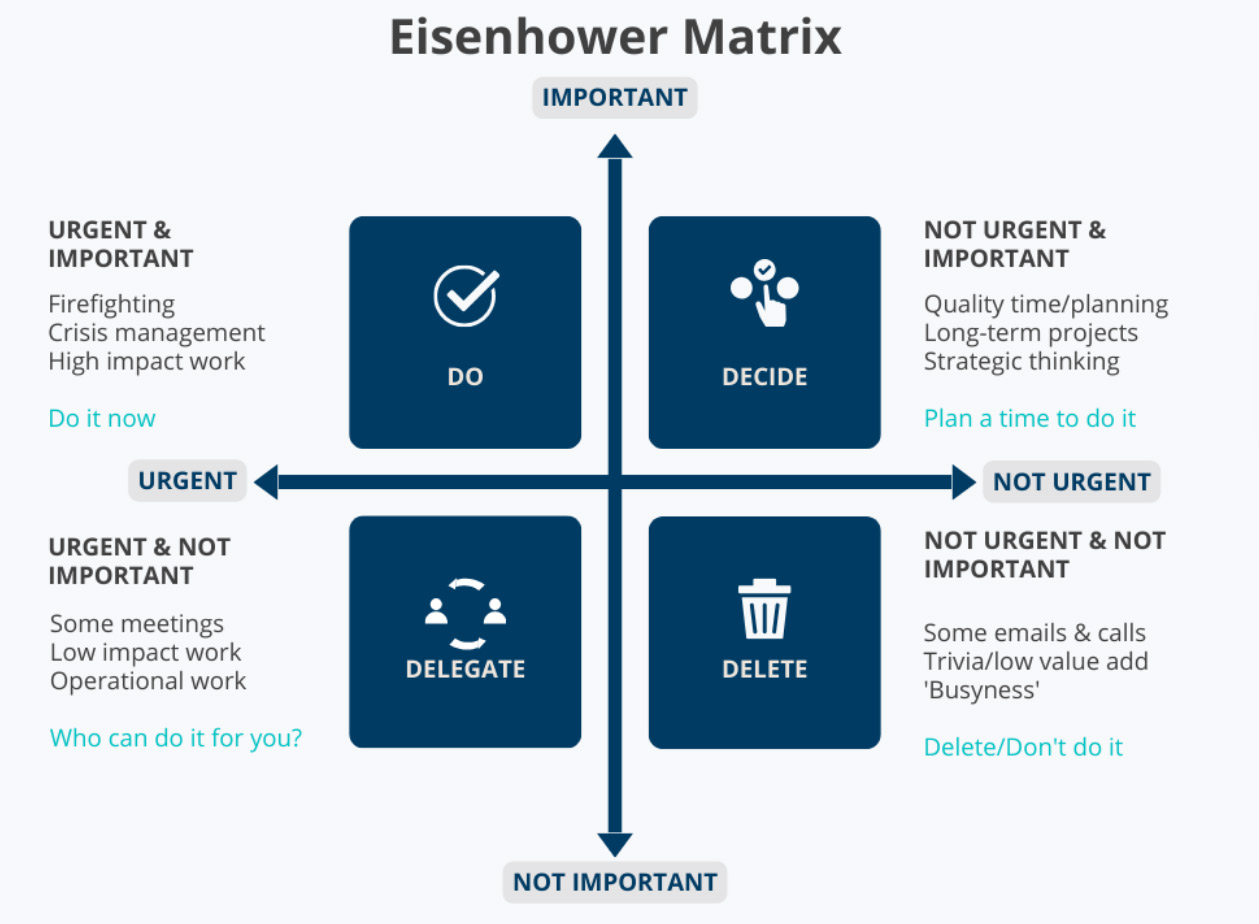
Moreover, this transition to the “important, not urgent” quadrant is a side effect of regularly applying the Powerful time system, combined with focus and buffer blocks, strategic planning, and long-term planning. It all happened smoothly and almost unnoticed (something I couldn’t achieve before, despite my efforts).
But first, the main benefits that emerged:
1. Productivity has increased significantly.
2. I was able to tackle more complex tasks, which previously overwhelmed my brain’s prefrontal cortex.
Over the years, I almost never postponed my vacations, and I stopped living in a rush, where I had to stay up late at night.
How Did I Work Before?
The first 10 years of my career, from ages 19 to 29, flew by rapidly. In terms of intensity and productivity, I could condense those years into six months of my current life.
There were many social events, which were fun and cool overall, but also a lot of chaos and a complete lack of conscious planning and daily structure.
I usually woke up around noon, often already tired, drank a couple of cups of coffee, and did some trivial tasks that could have been delegated, occasionally interrupted by urgent and mandatory ones (by the way, I was the head of a company at that time). I went to bed around 3-4 a.m.

The coffee and disorder were exhausting, so I spent more time idly at the computer than working productively. Many unconscious workaholics experience this—ineffective work for the sake of work, which often only appears productive. The main thing was not to be distracted from it. All of this was in my “blind spot.”

My internal “battery” had such a small capacity that a couple of tasks a day consumed all my main resources.
Now, I can publish a major book, support ongoing projects, and accomplish many other things. Tasks that now take me 2-3 weeks used to take 2-3 years.
“What’s Going On?”
At that time, I began to wonder what was happening. How can one become more effective?

Initially, I relied on esotericism and tried sleeping only five hours. But at least I was heading in the right direction.
Naturally, it wasn’t just the lack of theory about Powerful Time and productivity that held me back. The system that helps me now is much broader.
My personality’s immaturity (high infantilism and egocentrism) greatly interfered. Because of this, I clung to everything, inflated issues, dramatized, and so on. Instead of simplifying, I complicated many things. I lived in chaos and drained a huge amount of energy here and there.
Later, I wrote a book on immaturity called “Not Given Enough”
Alcohol, which was quite abundant in my youth, also interfered.
Lack of sleep, as I tried to “hack the system” and achieve more than others, was counterproductive.
The lack of strategy and planning got in the way. Understanding my goals in the basic spheres of life was missing. I didn’t have a sense of self; I didn’t understand who I was, what I was about, or how I wanted to live.
Sounds familiar, right?
It’s a typical scenario.
Almost EVERYONE goes through this! So don’t worry if you’re experiencing something similar right now. It’s common for everyone.
It took me about 15 years to understand all of this, put it together, and work through it. Over time, the puzzle pieces formed a complete and clear system, with each element in its place.
Of course, it’s not just about the Power Time of Day — and I must emphasize this — but it’s a quick and powerful basic tool. By implementing just this one aspect, you can significantly change your life.

How Was The System of Daily Blocks and Power Time Born?
It all started with Breus’s book “The Power of When: Discover Your Chronotype — and the Best Time to Eat Lunch, Ask for a Raise, Have Sex, Write a Novel, Take Your Meds, and More”, which discusses four chronotypes: Bear, Lion, Wolf, and Dolphin. I highly recommend it.

I began experimenting with my day, rearranging the blocks and measuring what was happening. It was an “Eureka!” moment.
Then, I developed many of my own insights and additional understandings.
In some areas, I began to disagree with Breus, realizing that some of his advice didn’t suit me at all as a Lion.
Next, I combined this concept with the idea of focus and buffer blocks, which I learned from one coach.
I added several other components, creating a multidimensional and effective system.
Over time, I saw participants in my courses — Wolves and Dolphins — transform into Bears and Lions, with Bears often becoming Lions. This shift is largely due to bringing order to their lives and psychological maturity. The biological chronotype, which seemed inherent from birth, became less defining.
Interestingly, this approach should be widely known and applied at every step. Yet, I hardly know anyone who consciously works with blocks daily (except for the participants of my courses).
Occasionally, I come across information online about biological prime time or the most productive time.
Still, I haven’t encountered a theory like mine—involving measurements, expansion, strengthening, adding enjoyment to the Power Time of the Day, and more.
How Do You Identify Your Power Time?
In short, it’s your biological prime time — your naturally strongest time.
If you eliminate excess caffeine, the effects of alcohol, and lack of sleep and get at least some rest the day before, you can easily identify it. However, over time, you might revise everything.
Therefore, I recommend taking measurements and analyzing for a while—a couple of weeks, for example — and not stopping there.
Then, it becomes simple.
For most people (Bears, according to Breus), it will be from 7-8:00 a.m. to 1-2:00 p.m.
For Lions (who like to get up early), it will be from 5-6:00 a.m. to 12-1:00 p.m.
For Dolphins and Wolves, it will be sometime in the afternoon, evening, or even at night. But these types are the fewest. And, as I mentioned, they can often migrate to another type with an earlier wake-up time.
For most people, the day’s structure will be built similarly to what I have developed.
How Do I Work Now?
Now, I absolutely do not sacrifice sleep (I often sleep for 9 hours) and my three daily blocks of rest.
Because I am rested, I work much better. This is so obvious after taking measurements that I no longer want to repeat old habits.
In general, consciously living each day is a completely different experience. What used to be in the blind spot becomes heartfelt, a hypothesis that no longer needs proving.
In the morning, I have a pleasant, quiet time for myself.
I do mostly the things I love — my “Yes” and “Hell yes!” (Most of the “No’s” are gradually left behind).
I do everything quickly, with almost no procrastination. If it does arise, I catch it quickly. Internal dialogues, resentments, and struggles with circumstances or people have practically disappeared. I switch tasks quickly, and my capacity has grown.
As a result, I can fit a lot into one day.
And the best part is — I’ve already packaged all of these instructions and all the techniques I’ve discovered! It’s all there already! You can just take it and use it!
If you’re ready to discover dozens of these life-changing hacks — join me here and you’ll find 44 of my absolute favorite techniques.
What Principles Now Underpin My Daily Routine?
1. Separation of focus and buffer blocks (I don’t mix important, complex tasks with routine, distractions, and unimportant tasks).
2. Clear highlighting of the Power time of the day and its maximum protection.
3. Flexible daily blocks. One block can range from 15 minutes to 6-7 hours, depending on the day’s demands. But I always include each of these blocks. I never skip any of the rest or work blocks.
4. Rest as a reward for a productive work block. I live by the principles “Wherever you look, I’m doing well” and “Everywhere you look, there’s joy.” I sprinkle nice things throughout the blocks. I also have them consciously and during the Powerful time of the day.
5. In each block, I do exactly what I planned. In the rest block, I rest. In the sleep block, I prepare for sleep or sleep. In the buffer block, I handle routine, unimportant tasks. In the focus block, I tackle important and difficult tasks while my prefrontal cortex and physical resources are at their peak. During work hours, I am fully engaged and active. There’s no situation where I find myself working during the sleep block. How could that happen? Why would it?
6. Closed blocks. Flexibility is essential, but each block closes at a specific time (at the junction of natural rhythms and my schedule). I know I need to work only 4-5 hours during my Powerful time. So, I work hard on the right tasks. Then, there will DEFINITELY be rest; you will rest! You can check your social networks! But now — work! Later, you will have an easy block — Powerful Time No.2. You might even watch a series! In the meantime, work on the complex and important tasks related to music or silence.
7. I cross out completed tasks daily, which I clearly plan in the Essential PIM program. This way, I always know which tasks to complete during Powerful Time No.1 without any questions.
8. Well, everything is built like a pyramid, starting from my plans for larger periods—a week, a month, a quarter. For example, right now, it’s the “Mass” quarter, so I’m engaged in various new social networks and types of content. I’m also writing this article during my Powerful Time of the Day.
My Daily Blocks Are Now As Follows:
BLOCK 1. Pleasant morning (on average, it starts around 5:00 a.m., but I wake up without an alarm clock, so it varies.
By the way, my 11-year-old son also wakes up without an alarm clock around 6-7 a.m. and enjoys having plenty of time for himself before school.
BLOCK 2. Power Time No.1: This is the most productive time of the day, during which I also highlight the Golden Powerful Time. This is my trump card of the day. I consciously speed it up, amplify it, stretch it (if necessary), and add enjoyment to it.
I usually work actively to music that helps, at speeds of 1.5-2 times on the most difficult tasks.
All this is done with breaks that save my eyes from fatigue and “magically” help maintain order at home, do exercises, and do other things. I call these Magic Pauses.
BLOCK 3. Rest (lunch). “Recharging the battery” with energy-restoring activities.
BLOCK 4. Power Time No.2 (aka, in fact, Weak Time of the Day — here, I don’t do anything difficult anymore and often work while watching a TV show in the corner of my monitor.
Most people mix everything up and try to tackle difficult tasks during their weaker times of the day.
The resources of the prefrontal cortex are almost depleted, and physical strength is running low. There’s no energy to push oneself or maintain control, which is when most procrastination occurs.
As a result, they’re just kicking a “dead horse.”

BLOCK 5. Free evening time. Buffer until the evening rest. Training, spending time with my son, and various activities. Rest before bed — 1-2 hours.
These 5 blocks are always in this order.
They are flexible and vary in size, depending on the day’s context and overall situation.
What Else
Like any system, this one has many “buts,” nuances, remarks, and other other considerations.
This is just the foundation. Most people will find it similar to their own experience, but not everyone.
Some individuals have a different chronotype, and a completely different work mode will suit them. However, the concept of daily blocks will remain similar.
For some, exercise or studying is the most crucial part of the day, and it takes place in the morning, during their Power time.
Participants in my courses who tried to move their workouts to lunch felt worse during their Power time 1. It was more important for them to work out in the morning, even if it shortened their Power time 1 because they could work more actively rather than increase their Power time and exercise later. This effect was prevalent among men.
Some people have children or uncontrollable circumstances in the morning, such as meetings or work, that prevent them from doing important and challenging tasks in the morning. Such cases call for optimizing systems, refining something, discarding unnecessary elements, or resolving conflicts between systems. Sometimes, we enhance the second Power time to make better use of it.
Additionally, this approach is quite flexible.
Sometimes, after working through addictions, immaturity, lack of sleep, or lack of interesting plans, reducing the number of pressure sources, and organizing their life, a person who previously stayed up late suddenly finds that they enjoy getting up at dawn and most productive in the morning.
I’ve already learned how to handle my routine masterfully, and it’s all a matter of time and conscious work with my day.
However, anyone can gradually build their system, starting with the most important step—determining their Powerful time of the day, protecting it from distractions, and spending it deliberately on essential tasks.
For 15 years, I was on a quest to master what I now call Power Time of the Day — testing, tweaking, and finally cracking the code that boosted my productivity 3-5 times without burning out.
But that’s just the tip of the iceberg.
Along the way, I uncovered dozens of equally powerful hacks: simple, game-changing techniques that close energy leaks, dissolve guilt in minutes, turn chaos into clear plans, and build unbreakable inner calm — all without meditations or rigid routines.
And it’s just $8.99/month (less than two lattes) — locked in forever. LIMITED TIME OFFER!
Ready to unlock your easier life? Join now, get your first lesson + bonuses instantly, and start feeling the shift this week. Click below — spots at this price won’t last!
What’s Waiting for You: 4 Power-Packed Lessons (Lifetime Access!)
Lesson 1: Unpack the Pressure – Sources & Why It Crushes You
Dive into what really fuels your daily grind: internal triggers (self-doubt, guilt) vs. external chaos (bills, demands)
See how it sparks procrastination, cheap dopamine escapes (scrolling, sweets, wine), and self-sabotage—even when you crave change.
Discover why resistance builds (that inner rebellion blocking your wins) and get your first toolkit to start dissolving it.
Walk away lighter, spotting the leaks before they drown you.
Lesson 2: The 7-Step Power Algorithm – Turn Chaos into Effortless Action
Unlock my core system: a dead-simple 7-step blueprint to unravel any tangled mess — from impossible deadlines to emotional storms—into bite-sized wins you crush in minutes.
We’ll practice live with a real-life bombshell example, reframing stuck into solved.
Shift your mindset from survival to strategy, simplify ruthlessly, and ditch what doesn’t serve.
Feel the fog lift — clarity and momentum hit hard by Day 2.
Lesson 3: 22 Lightning Techniques to Release Pressure (Part 1)
Blast through the first wave of my 44-tool arsenal: rapid-fire resets for emotional overload, want vs. must battles, and daily irritants.
Hands-on examples show you how to legalize joy (hello, guilt-free micro-breaks) and prevent buildup before it buries you.
These aren’t fluffy tips— they’re weapons to shatter resistance and reclaim your power.
End the day energized, not erased.
Lesson 4: 22 More Explosive Techniques to Release Pressure (Part 2)
Finish strong with the ultimate arsenal: targeted strikes on physical tension, people-pleasing traps, perfectionism, and future-fears.
From silencing inner critics to handling external demands like a pro, you’ll master quick-draw relief that sticks.
Feel unbreakable confidence surge — your new baseline: calm amid storms, with energy to chase dreams, not just survive.
Lifetime access means these tools evolve with you.
You’ll Also Get These 9 Life-Changing Bonuses:
1️⃣ How to stop the chaos in your head
2️⃣ What to do with cheap dopamine (sweets, screens, distractions)
3️⃣ How to function when you’re sleep-deprived
4️⃣ How to clear out all the useless and obsessive thoughts
5️⃣ The “Zigzag” technique — balance multiple areas of life easily
6️⃣ A new approach to the “Small Steps” technique — progress even when you’re tired
7️⃣ Deadline mastery system — no stress, no guilt, pure flow
8️⃣ How to get rid of your fears and why they appear
9️⃣ What’s in your zone of control — and what’s not – the Full List